Notes from Rothbury CAN meeting 22.4.26
Three officers from the Wildlife Trusts attended, which made the discussions very fruitful and wide-ranging. The meeting therefore lasted longer than usual, because we all wanted to continue the dialogue!
Feedback from groups
Rothbury Trees: The Rothbury Tree Trail continues to attract compliments from visitors. One of the trees, the Chestnut by the War Memorial, and the article about it on the website, has been mentioned by some visitors to Rothbury, arriving from Australia, in June. They have asked for a guided tour of the Tree Trail - and particularly to hear from this tree - as the tree talks about Robert Hounam, who died in WWI in Australia. These visitors are Robert's family. See the article here for more detail: Robert Hounam, Dippie Dixon, and The Valley Remembers.
Tod's Place, Xmas Trees, Woodland Volunteering
Mark Shipperlee reports:
Tod's Place: So finally the ground is drying out and work can start on the community tree nursery at Tod's Place (just opposite the entrance to Brinkburn). We had a great day with volunteers planting 800 hedgerow saplings earlier in the year - and then two days of potting on Seeds2Trees saplings (grown by volunteers) in March.
The land also has markers installed to help with the woodland creation planning - and the first draft of our application for woodland creation funding is about to go to the local Forestry Commission woodland officer.
Parish councillors (Brinkburn and Hesleyhurst) and neighbouring landowners had a site visit with an all-round positive response.
So next will be establishing the community tree nursery infrastructure - deer fencing, water supply etc over the next couple of months - and hopefully a chance for people to volunteer to help put a “kit” log cabin/shed together on the site.
Xmas Trees: Exciting opportunity... Rothbury Mart - November/December - Trees for Christmas.
We were approached by Forestry England last Autumn as to whether we would be interested to run the Christmas Tree Sales at Rothbury Mart from this year, as they are no longer going to be doing it. It was a national decision, rather than low sales - in fact this year they sold out a day and half early.
Living Woods directors have agreed in principle - with the aim to develop it into more of an “experience” over the future years, if we can make it work. We are keen to let people know for definite as soon as possible, and we will really need local people continuing to support by buying a tree - as a not-for-profit organisation, we see this as a way of generating a small amount of extra funds for our work, as well promoting what we do.
We have agreed that we will only sell British grown trees, Spruce and Nordmann Fir, and run a similar event to Forestry England, but we are looking to add potted lived trees - and also looking at 'circular economy' with working out whether we can offer to collect and chip the trees after Christmas - as an extra service, and to ensure that the trees get a form of second use. We have finalised things, we will start getting the message out across the Coquet Valley.
Please note - the Christmas trees are grown specifically on fields - these are not cut from forests and woodlands - they are a crop.
Woodland Volunteering - Shilbottle
A lot of our work is about engaging volunteers in woodland creation and woodland management. Our nearest regular volunteering group is Shilbottle at this time, run by my colleague Peter. Over time we aim to establish regular sessions at Tod's Place, but at this time it is a bit ad hoc, as we get all the agreements and funding in place.
Mark Shipperlee Living Woods
Coquetdale Repair Café: Elidh reported that there is a plant to have outreach activities. Originally, CRC had planned to take CRC up the valley. But they have so much equipment it turns out that this is not going to be feasible. HELP needed - they need more people to staff the reception desk at the Repair Cafes. CRC in 2026: 25th April, 27th June, 19th September, 21st November. Please contact Coquetdale Repair Cafe if you would like to help.
CRAG
Coquet River Action Group will be starting soon to organise sessions to pull out Himalayan Balsam (a non-native invasive plant species). We usually go for a couple of hours at a time. It pulls out very easily and is very satisfying. If anyone is interested in joining us please get in touch with Wendy Redmayne, via [email protected] (your email will be forwarded to Wendy).
ROWANS:
Have revamped the willow structure at Beggars Rigg and planted more trees near the Hospital Car Park.
Sustainable Energy/Transport: Monica explained that the group are looking for funding for a feasibility study for sustainable energy for Rothbury/Coquetdale.
Monica reported that this group had attended a meeting in Felton.
At this meeting, Alan spoke about getting Energy from Rivers. This is the gist:
Energy from Rivers
Community projects using water source heat pumps (WSHPs) to extract energy from rivers, canals, and harbours are becoming increasingly common for district heating systems. These projects typically abstract low-grade heat from the water and upgrade it to high temperatures for heating and hot water in residential, commercial, and public buildings. Examples in the UK include projects in;
Liverpool, Bristol, Cambridge, Glasgow, etc.
Local example at East Newtown, where I have 20 years' experience running a water-source heat pump using water that flows into the Coquet.
Using solar panels, batteries, and a water-source heat pump, the annual heating and lighting costs for our 17th-century 4-bedroom farmhouse amount to around £750. This compares to the annual cost of over £3k without the integrated systems
Liverpool System Quote - “The launch of the Mersey Heat Energy Centre is a landmark moment in Liverpool City Region's journey towards a cleaner, greener future.
“It is a visible example of how we are leading the way on low carbon infrastructure, protecting historic buildings, cutting emissions and creating long term green value for our communities.
“Liverpool has long been a leader in climate action, and this project reinforces our commitment to achieving net zero. It's not just about infrastructure, it's about creating a legacy of sustainability that benefits our communities, our economy, and our environment".
Bristol System Quote - "In 2018, Bristol City Council declared a climate emergency and set targets of reaching carbon neutrality by 2030.
One of the schemes which will make a strong contribution to this is the Castle Park Heat Pump Project, which will pump water from the nearby floating harbour, use a state-of-the-art heat pump system to increase the temperature to 70-80°C, and distribute it to homes and businesses via the Bristol Heat Network"
Update from Northumberland National Park
Isabel Plummer, Climate Officer
Isabel sent the following report. After reading this, a most interesting discussion ensued. We agreed we would love Isabel to come along to a future meeting, to explain more about this.
The UK National Parks have recently joined the Landscape Observatory which is a new project run by the Protected Landscape Partnership. It will be using AI to generate high resolution maps for each landscape, to inform future decision making for land management. It will help monitor habitats, heritage over time, and enable informed management of the landscape for climate adaptation.
Even under the lowest emissions scenarios many of our National Park features (habitats, ecosystems, land use, visitation, cultural) will endure rapid transformations in the coming decades.
As a result, climate change adaptation must be considered in the management planning process. Landscape Observatory is helping to start the conversation around using an emerging informed risk/decision making framework to facilitate this. This will look like a 'Resist', 'Accept' and 'Direct' approach. Features of a landscape will be monitored and changes will either be resisted, accepted or directed, based upon the impact of climate change on that feature. Moving beyond 'restoring and protecting existing patterns' of biodiversity, wildlife and heritage conservation, requires a new approach. Instead, rapid change may be appropriate to accommodate new scenarios and recalibrate the notion of 'acceptable change'.
For example, in the longer term (2080s), moorland habitats may not be able to withstand drought and heat stress; adaptation action may have to adopt a Resist, Accept and Direct framework. In the case that resisting change would cause greater ecological or carbon loss, then there should be an acceptance that some moorlands may transition naturally toward scrub. Actions to move towards a functioning habitat in future conditions, could include directing woodland expansion to slope edges and mineral soils; creating mosaics of heath, scrub, and woodland that retain carbon and biodiversity; introducing drought-tolerant native species in areas where moorland vegetation consistently fails.
Wildlife Trusts
We were delighted to welcome Paul Barrett, Sophie Bulgin, and Peter Batchelor to the meeting. They explained the work that is currently being done on the Rothbury Estate. This work is being done in conjunction with Oxford University, Newcastle, and St Andrews Universities.
One area is the fitting of eco-accoustic monitors to get a baseline of creatures can be heard.
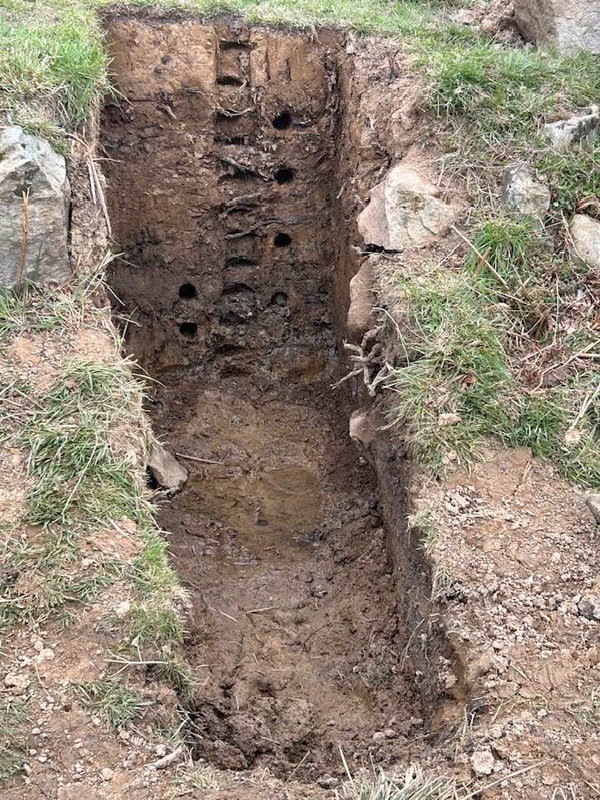
Another area is the digging of test pits to discover, using environmental DNA and Bioluminescence to age the soil, and find out what plants lived there.
The discussion which followed was absolutely fascinating and inspiring.
Going back in time
Next Meeting
Thursday 21st May 7.00 pm Venue to be confirmed.